
What it does
Zapier now makes more sense as an AI orchestration platform than a simple integration service. Zaps, Tables, Forms, Zapier MCP, plus Agents and Chatbots all sit in one product for teams that want workflows, structured data, and AI actions without maintaining their own automation stack.
Plans
Free - 100 tasks/month with Zaps, Tables, and Forms in one plan
from $19.99/month for Professional; Team starts at $69/month
Access
Free now includes unlimited Zaps, Tables, and Forms within the task cap, two-step Zaps, and Copilot with a daily limit. Paid plans unlock multi-step Zaps, Premium apps, team controls, and stronger support.
Screenshots
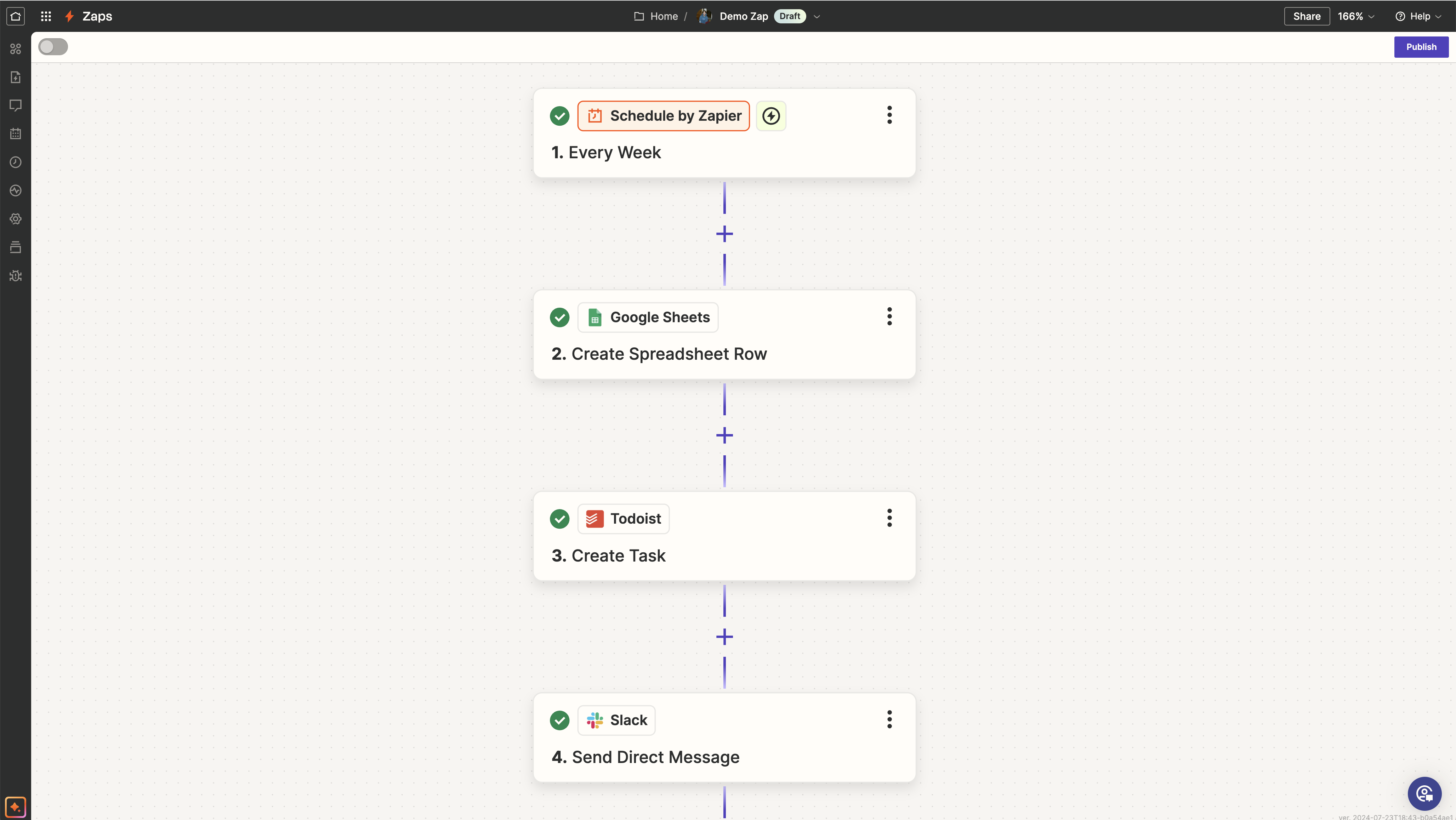
Usage examples
A form, a table, and a CRM in one flow
Zapier works well when a form needs to flow into a table, then into a CRM and notifications. It is not exotic, but it is one of the most common and useful automation patterns.
DocumentationLaunching a multi-step workflow quickly
When a team needs to connect several services without building a separate backend for the logic, Zapier usually wins on launch speed. Not always on flexibility, but definitely on time to first result.
DocumentationAn AI layer on top of connected apps
Zapier is not just about one-off integrations anymore. It matters when an AI action, a table, a form, and a connected app need to live in one orchestrated flow instead of four separate tools.
DocumentationApplication scenarios
An ops team pulls forms, tables, bots, and integrations into one working layer. Zapier is useful here because the product now covers several adjacent jobs, not just automation itself.
A team optimizes for launch speed instead of owning a custom backend layer. In that scenario Zapier often wins because a workable system can be assembled in a day.